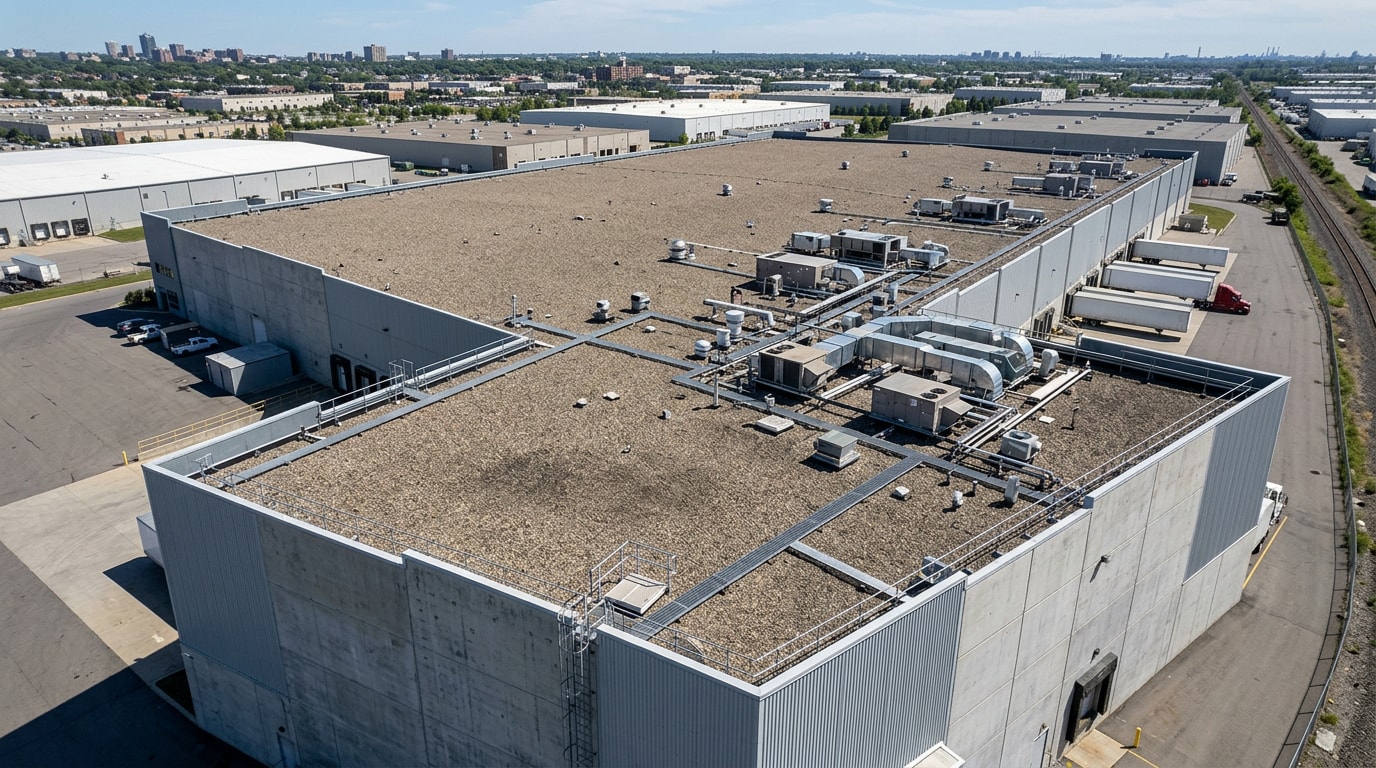
Built-up roofing (BUR), the original "tar and gravel" system, is still specified on commercial buildings today because its layered design keeps working even after the top surface takes damage. This guide breaks down how BUR is built, what it costs in 2026, how long it actually lasts, and whether it still beats a single-ply membrane for your building. We'll also flag the trade-offs, like tear-off weight and hot-asphalt fumes, that most guides skip.
What Is Built-Up Roofing?
Built-up roofing (BUR) is a popular choice for buildings with low-slope or flat roofs, and this system has been used in the US for over 100 years.
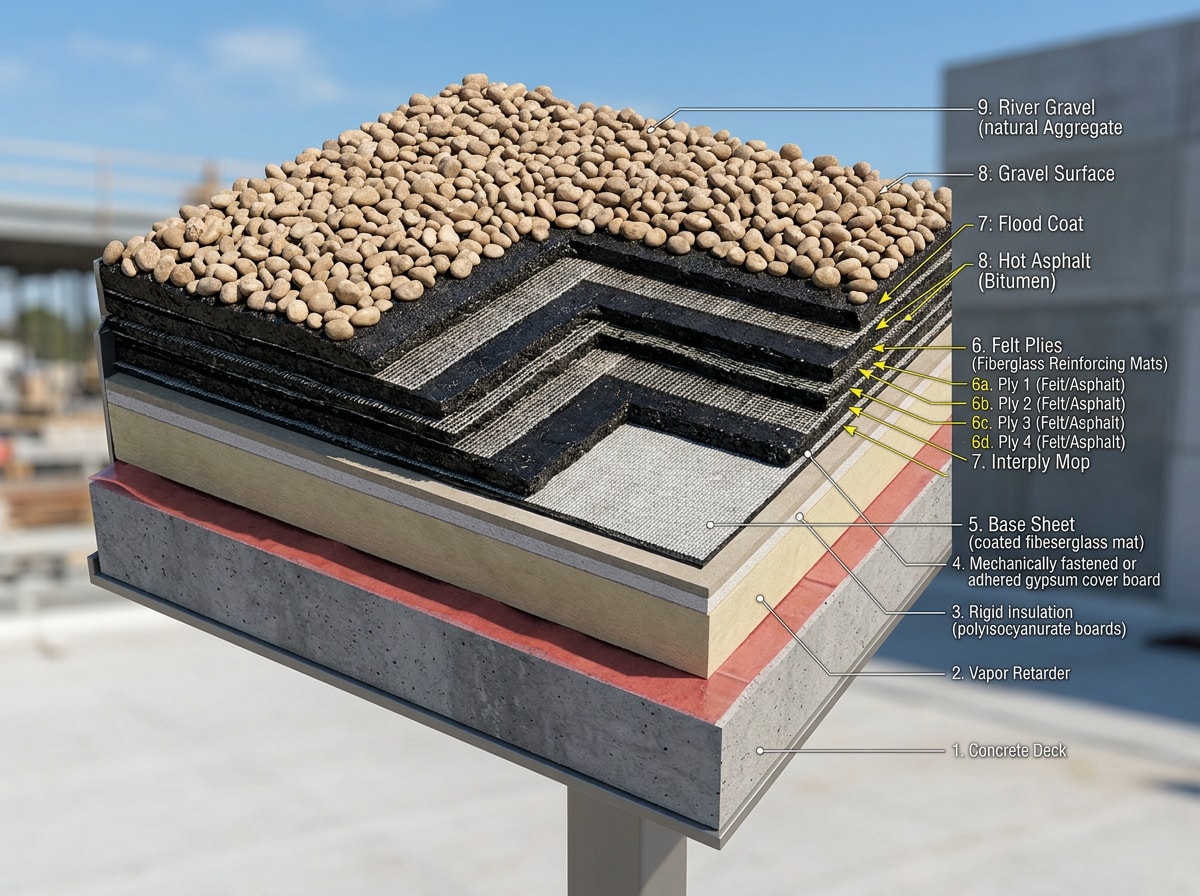
The Asphalt Roofing Manufacturers Association defines it as a roof where multiple layers of asphalt alternated with ply sheets are applied over the roof deck, most often over insulation attached to the decking.
BUR systems are known for providing excellent protection due to their redundant nature, made of multiple layers of ply sheets and asphalt that give the building weather resistance and heavy-duty protection.
These layers are then topped off with a cap sheet or a flood coat of asphalt and gravel.
That layering isn't just for thickness. If the top layer is damaged, the layers underneath provide a back-up to stop water and the elements from entering the building. This redundancy is the main reason BUR has stayed relevant on low-slope commercial roofs even as newer single-ply options have entered the market.
Most BUR assemblies start with a base sheet installed over polyisocyanurate insulation or a cover board, typically using mechanical fasteners. From there, crews alternate hot asphalt and reinforcing felt until the assembly reaches the specified number of plies.
Building owners comparing flat-roof options often start by talking through whether a layered BUR assembly fits their structure. Our roofing contractor team can walk you through that before you commit to a system.
Materials Used in Built-Up Roofing
BUR performance comes down to three material categories working together: waterproofing bitumen, reinforcing felts, and a surface layer. Each plays a distinct role, and getting the combination right affects both cost and lifespan.
Bitumen and Reinforcing Felts
The most commonly used bitumen on BUR roofs is asphalt or a cold-applied adhesive. It binds every layer of the assembly and cures into a continuous, seamless seal across the deck.
Felt material, made of glass, organic, or polyester fibers, is designed to act like reinforcing steel in concrete, resisting the pulling forces in the roofing material. Most commercial BUR assemblies use three to five plies, alternating bitumen and felt, before the surface layer goes down.
Surfacing Options: Gravel vs. Mineral Cap Sheet
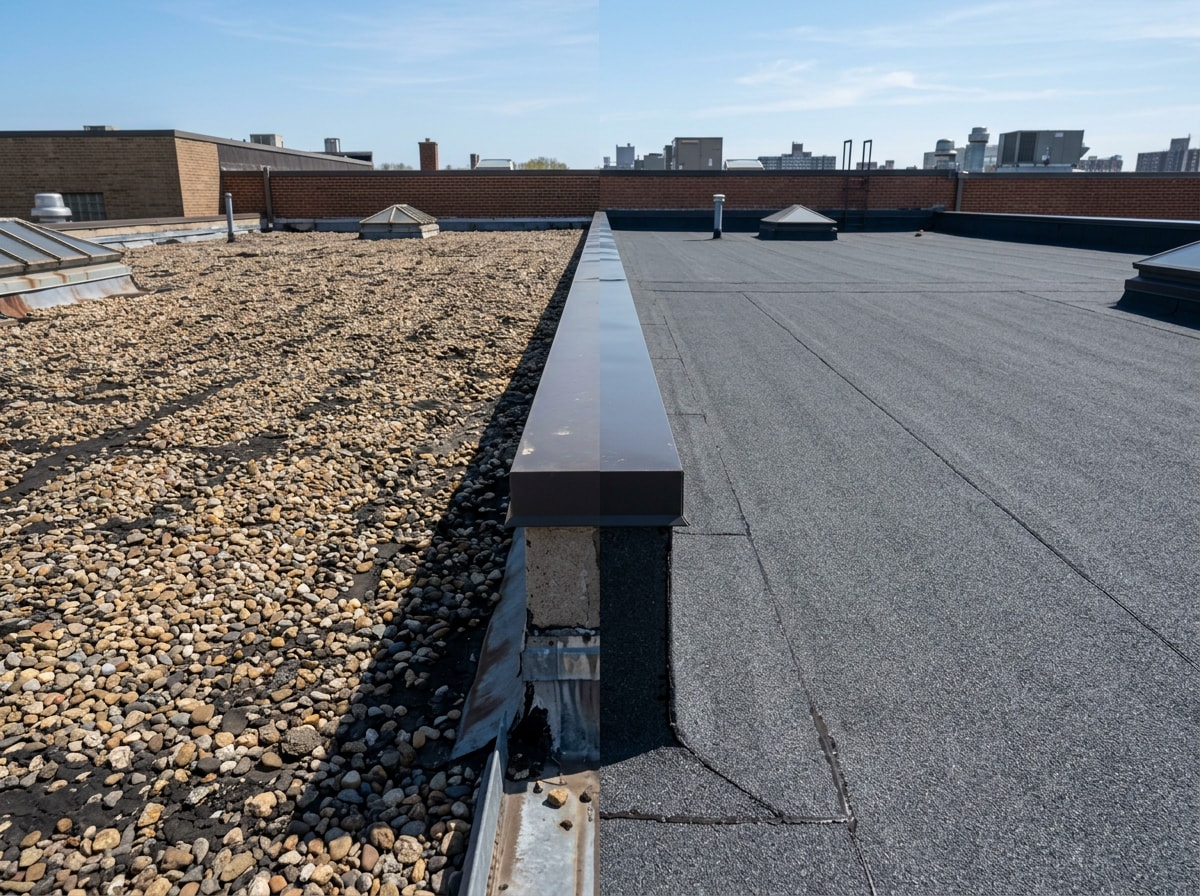
Gravel-surfaced BUR is the classic "tar and gravel" roof most people picture. It's the traditional surfacing option that most people picture when they hear the term BUR. Mineral cap sheets swap that gravel and flood coat for a factory-made, granule-faced modified-bitumen sheet.
Gravel surfacing adds roughly 5 to 7 pounds per square foot to the finished assembly, an important structural consideration for older buildings or lightweight steel deck construction.
That added weight also makes gravel BUR one of the most difficult systems to tear off at end of life.
A side-by-side look makes the trade-off clearer:
| Factor | Gravel-Surfaced BUR | Mineral Cap Sheet |
|---|---|---|
| Added weight | Roughly 5-7 lb/sq ft | Lighter, no loose gravel |
| Fire rating | Strong when tested to ASTM E108/UL 790 | Also achievable, varies by product |
| Tear-off difficulty | Higher, loose aggregate slows removal | Lower, sheet peels in sections |
| Typical use case | Large commercial roofs, heavy foot traffic | Roofs needing lighter dead load |
Fire performance for either surfacing option is verified through a fire-test-response standard used to evaluate roof coverings in both residential and commercial applications on combustible or noncombustible decks , per Intertek's ASTM E108 overview. Class A ratings, the toughest tier, are what most commercial specs call for.
Advantages of Built-Up Roofing
BUR's multi-layer design distributes stress across the whole assembly instead of concentrating it on one membrane, which lowers the risk of a single puncture becoming a leak. The multiple layers also create a more rigid, stable surface, which makes the system a better platform for mechanical equipment, solar arrays, rooftop gardens, or a usable roof deck.
Built-up roofing systems exhibit exceptional resistance to heat conduction between the exterior and interior of a building, which incorporates insulation into the monolithic assembly for a higher effective R-value. That thermal performance, combined with a reflective cap sheet or coating, can trim cooling costs over a hot Colorado summer.
We've re-covered aging gravel-surfaced BUR on strip malls and light-industrial buildings across the Denver metro where the ballast had scattered into gutters after repeated hailstorms. In those cases, the plies underneath were still doing their job, which is the clearest real-world proof of BUR's redundancy advantage.
Built-Up Roofing vs. Other Roofing Systems
Unlike single-ply systems that rely on one membrane, built-up roofing uses redundancy: if one layer becomes compromised, the remaining layers continue to protect the building, making BUR one of the more resilient roofing options available.
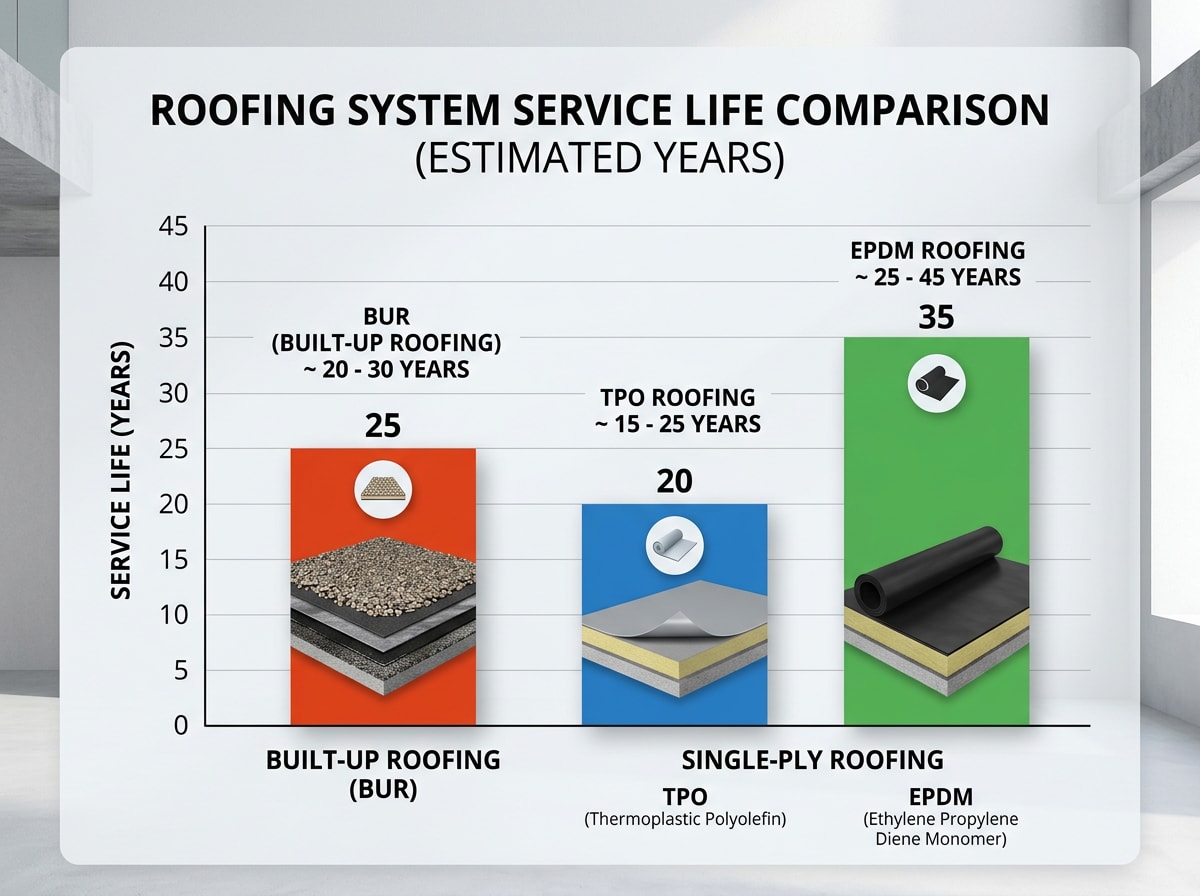
Lifespan comparisons aren't as one-sided as some guides suggest. Built-up roofing costs $3.50 to $7.50 per square foot installed and typically lasts 20 to 30 years. EPDM, a single-ply membrane, is sometimes rated similarly or even longer under ideal conditions, though it's more vulnerable to punctures than a layered BUR system. TPO tends to install faster and lighter, which shifts the decision toward how long you plan to own the building rather than which system is objectively "better."
For a fuller side-by-side on flat roof materials, our flat roofing company guide walks through BUR, TPO, EPDM, and modified bitumen in one place.
Built-Up Roofing Cost in 2026
BUR pricing swings based on surfacing choice, tear-off complexity, and regional labor rates, so no single number tells the whole story. Instead of citing just one estimate, here's how three independent sources price BUR in 2026:
| Source | Cost per Sq Ft | Notes |
|---|---|---|
| HomeGuide (2026) |
$3.50-$7.50
| Residential-leaning tar-and-gravel pricing |
|---|
| Homewyse (May 2026) |
$7.91-$9.82
| National average install starting range |
|---|
| Commercial Roof Guide (2026) |
$6-$10
| Commercial-focused, includes surfacing variance |
That spread exists because gravel versus mineral cap sheet, tear-off scope, and local labor rates all move the number independently. Even at the higher end, BUR often stays competitive with premium single-ply membranes once you factor in its longer service life and lower puncture risk.
Tear-Off Challenges and Costs
Gravel's added weight is the main reason BUR tear-off ranks among the most labor-intensive parts of a roof replacement. Crews have to remove and dispose of the embedded stone before they can access the underlying plies, which adds both time and disposal cost to the project.
Disposal isn't trivial, either. EPA estimated that 600 million tons of construction and demolition debris were generated in the United States in 2018, more than twice the amount of generated municipal solid waste. Gravel and saturated felt from a BUR tear-off count toward that total, and disposal rules vary by locality, so it's worth checking EPA's construction and demolition debris guidance before budgeting a full tear-off.
If your roof needs a full system swap rather than a patch, our roof replacement team can scope the tear-off and disposal cost up front, not as a surprise change order.
Built-Up Roofing Lifespan
Built-up roofing lasts 20 to 30 years on average.
Built-up roofs have a long life expectancy, often lasting 20 to 30 years or more with proper maintenance.
Well-maintained installations sometimes perform past that window, though that's the exception rather than the rule. A properly installed, routinely inspected BUR system more reliably lands in the 20-30 year range, still longer than most single-ply alternatives on a like-for-like maintenance schedule.
Maintenance Tips for Built-Up Roofing
Routine care is what stretches BUR toward the higher end of its lifespan. A seasonal approach works well:
- Spring: Clear drains, scuppers, and gutters of winter debris; check for ponding water that didn't drain after snowmelt.
- Fall: Inspect flashing and seams before freeze-thaw cycles begin; confirm gravel ballast is still evenly distributed.
- Ongoing: Reapply shifted gravel in high-traffic areas, and watch for multiple leaks or widespread blistering, which usually signal it's time to consider replacement rather than another patch.
A dedicated roof inspection on that same seasonal schedule catches most of these issues while they're still a coating fix instead of a full tear-off. If something does slip through between visits, roof repair can usually stop a leak without disturbing the surrounding plies.
Any hot-asphalt repair or recoating work involves fume exposure. These effects appear to be mild and transient, though some studies suggest roofers have an increased risk of lung cancer, and researchers aren't sure whether that risk comes from asphalt fumes or other hazards, so it makes sense to take steps to control exposures while research continues. Crews should follow OSHA's asphalt fume hazard guidance during any hot-mopped work.
Is Built-Up Roofing Right for Your Building?
BUR still makes sense for owners who value long-term durability and puncture resistance over the lowest upfront price. Weighing the construction method, surfacing choice, tear-off complexity, and full cost picture above should make that decision clearer.
Structural load capacity, budget, installation timing, and how long you plan to own the property all factor into whether BUR or a lighter single-ply system fits better. A properly designed BUR system starts with an honest site visit, not a phone quote, so it's worth getting a free estimate before you finalize either direction. You can also browse our full roof installation options or head back to our homepage to see everything we handle beyond flat roofing.
FAQ
How long does a BUR roof typically last compared to single-ply systems?
BUR roofs generally last 20 to 30 years, with some well-maintained systems running longer. TPO and EPDM membranes carry similar 20 to 30 year warranties in many cases, so the real difference is puncture resistance, not raw years.
What is built-up roofing made of?
BUR is made of alternating layers of bitumen (asphalt or a cold-applied adhesive) and reinforcing felts, usually fiberglass or organic mats, finished with either loose gravel or a factory-made mineral cap sheet.
Why does BUR cost more to install than other flat roofing systems?
BUR requires three to five material layers, specialized hot-asphalt equipment, and skilled labor to install correctly. That higher upfront cost often pays off since the system's longer lifespan and puncture resistance can make it more cost-effective over 20 to 30 years of ownership.
Is built-up roofing good for flat roofs?
Yes. BUR was designed specifically for flat and low-slope commercial roofs, and its ballasted, multi-ply surface handles standing water and foot traffic better than lighter single-ply alternatives.
What's the difference between built-up roofing and modified bitumen?
Modified bitumen is a factory-made, reinforced asphalt sheet installed in fewer layers, usually torched or self-adhered. BUR is field-built on site with multiple separate plies and hot asphalt, which is more labor-intensive but adds more redundant layers.
Is the smell and fumes from BUR installation a serious concern?
Hot asphalt does produce noticeable odors and fumes during installation. This isn't typically dangerous when crews follow proper ventilation practices and OSHA's asphalt fume exposure guidelines during the job.