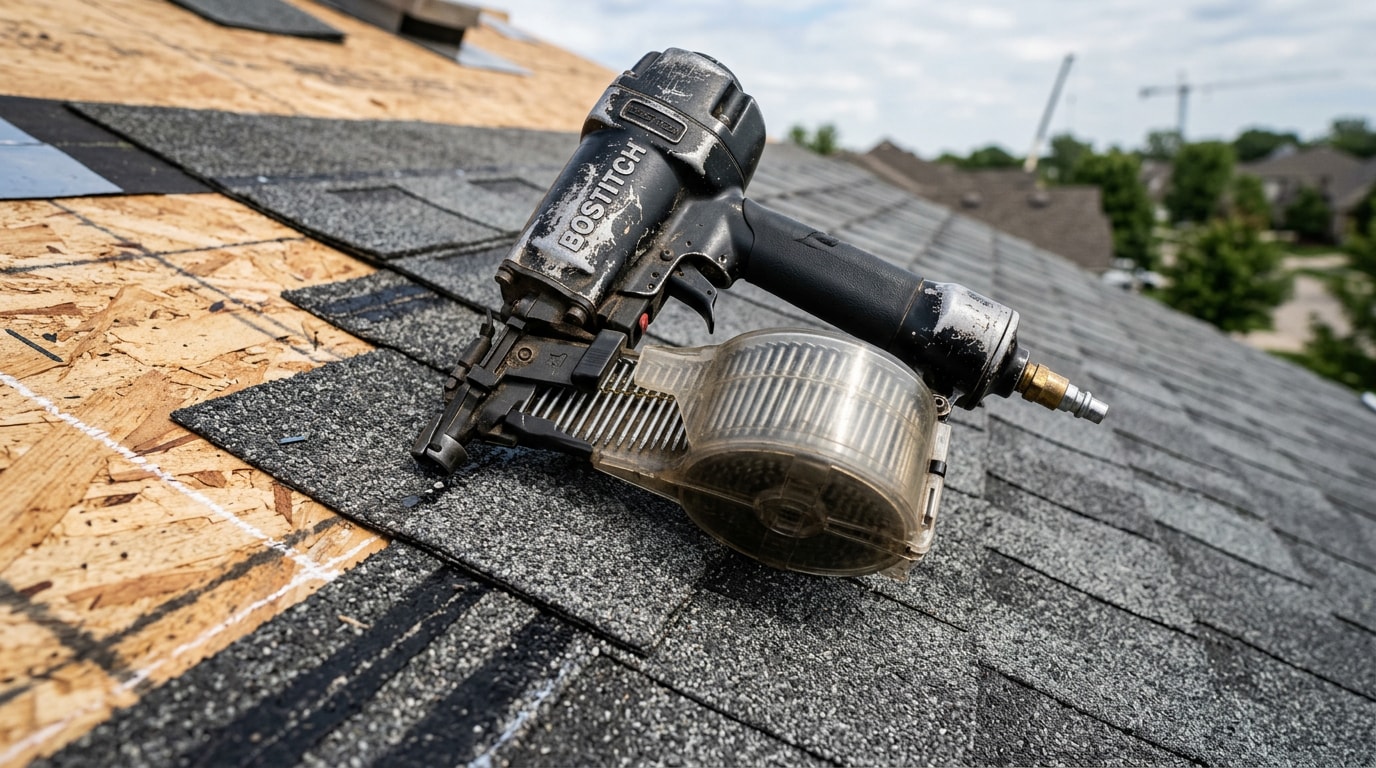
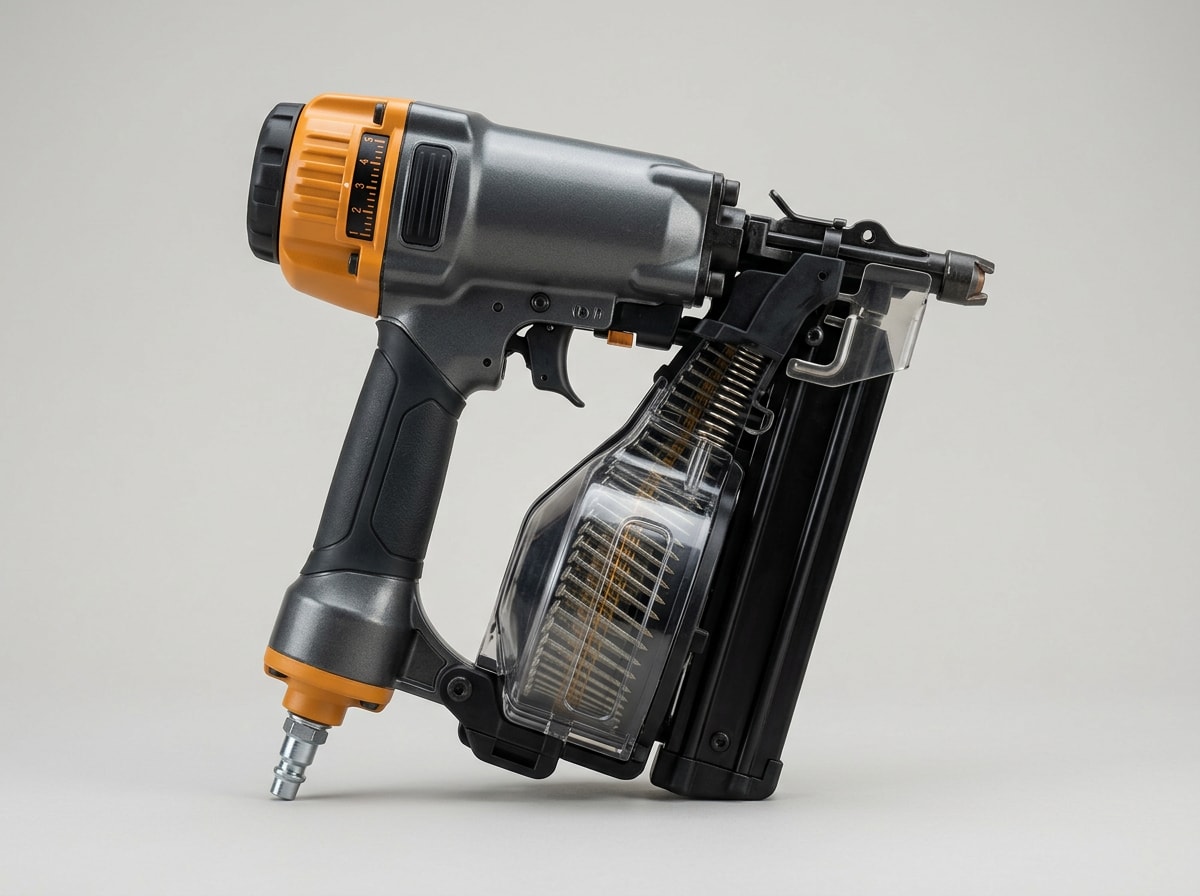
A coil roofing nailer is the pneumatic tool that keeps a shingle crew moving across a roof without stopping every few feet to reload. Its coiled magazine holds roughly 120 nails, compared to 30 to 40 in a standard strip nailer, which is why no major manufacturer builds a stick-fed gun for shingle work. Here's how the tool works, how to dial it in, and what separates a nailer that holds up on a full tear-off from one that jams by week three.
What Is a Coil Roofing Nailer?
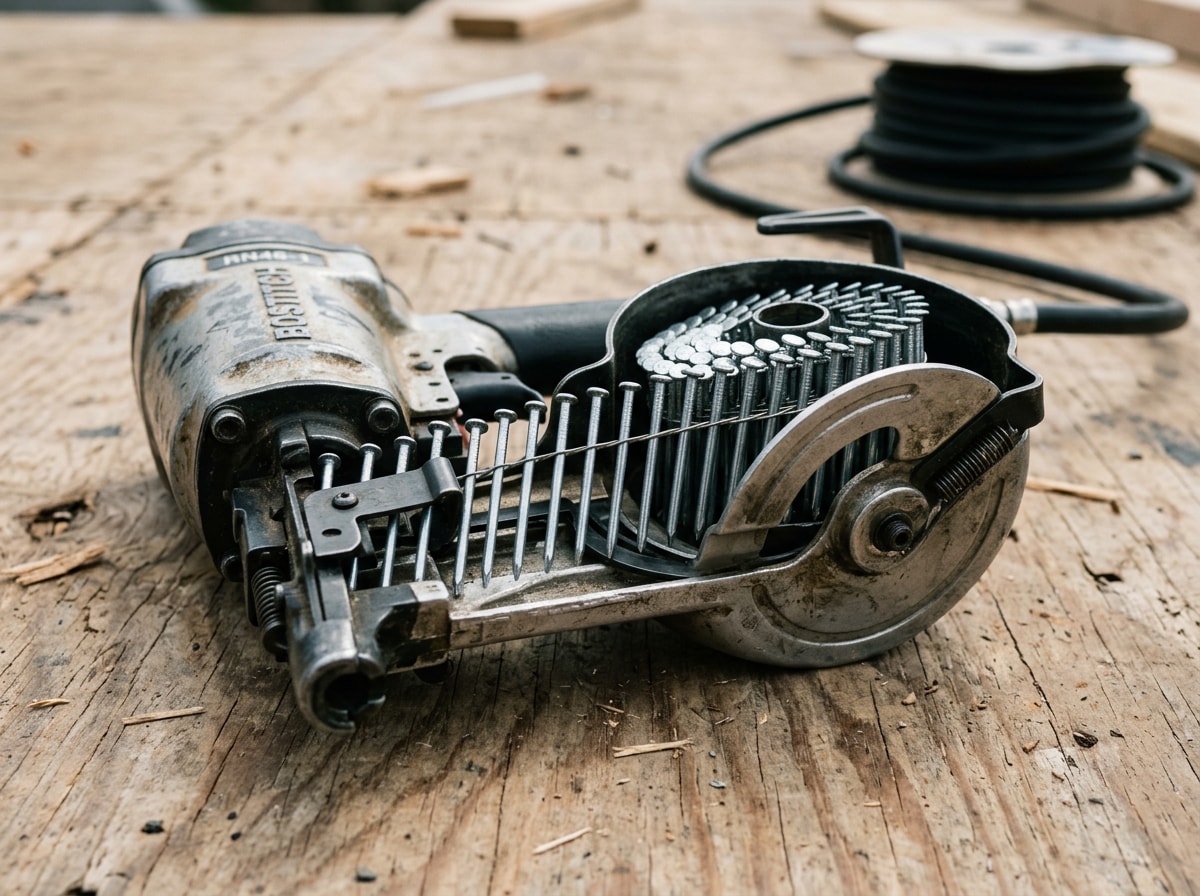
A coil roofing nailer is a pneumatic or battery-powered nail gun that feeds a coiled strip of wire-collated nails at a 15-degree angle, letting a crew drive fasteners continuously along pitches, eaves, and hips without pausing to reload every few shingles. The curled nail strip sits in a round magazine instead of a flat stick, which is what gives the tool its higher capacity.
These nailers are built for asphalt shingles, roofing felt or synthetic underlayment, and some lightweight metal panel systems. They're not interchangeable with framing or siding nailers, which take different nail lengths and collation types entirely.
On the Crestline Exteriors roofing crews, the coil nailer is the one tool nobody argues over at the start of a tear-off. The crews reach for it before the compressor hose is even uncoiled, because reload time is the one variable they can actually control on a timed job. It's standard kit across every roofing contractor job we run, from single-repair callouts to full replacements.
Coil vs. Stick: Why Roofing Nailers Are Always Coil-Fed
Roofing nailers are built around coils, not sticks, because the math doesn't work any other way. A strip nailer magazine typically holds 30 to 40 nails, while a coil magazine holds around 120, a difference that adds up fast once you're covering a full roof.
Take a 2,000 square foot shingle roof at roughly four nails per shingle, close to 5,200 nails total. A coil nailer needs around 43 reloads to finish that job. A stick-style tool, if one were built for roofing, would need closer to 150 reloads. That gap is exactly why no major manufacturer sells a production stick-fed nailer for shingle work.
Coil nailers do exist for siding and framing, but those run longer, thinner nails suited to lumber and trim, not the short, wide-head fasteners roofing calls for. Don't assume a coil nailer from one trade works for another. Crews handling a full roof installation or tear-off rely on the roofing-specific version for exactly this reason.
How Much PSI and Air Supply Does a Coil Roofing Nailer Need?
Most pneumatic coil roofing nailers operate in the 70 to 120 PSI range, though the exact number depends on the manufacturer and nail length. The right approach is to run the lowest pressure that fully seats a nail flush, not flat into the shingle, rather than defaulting to the top of that range out of habit.
How to Dial In a Coil Roofing Nailer (Test-Nail Procedure)
Start by setting the regulator toward the low-to-middle of the recommended range. Fire a few test nails into a scrap shingle over matching decking, then check the heads.
- Nail head sitting too high: increase pressure or deepen the drive-depth setting.
- Nail driven through the shingle paper: you've gone too far, back off in small increments.
- Nail flush with a slight witness mark: that's the target seat for most architectural shingles.
Adjust in small increments and retest rather than jumping straight to full pressure.
Compressor Size: How Much CFM a Coil Nailer Actually Uses
PSI only tells half the story. If the compressor can't keep up with airflow, pressure drops mid-coil and nails start seating shallow even if the regulator reading looks correct.
| Job type | Typical PSI | Recommended CFM | Tank size |
|---|---|---|---|
| Single nailer, repairs or small jobs | 70-100 PSI | 2-3 CFM | 4-6 gallon |
| Single nailer, full tear-off | 90-120 PSI | 3-6 CFM | 20-30 gallon |
| Two nailers off one compressor | 90-120 PSI | 6-10 CFM | 30+ gallon, two-stage |
A compressor rated for the nailer's peak PSI but short on CFM is the most common reason a crew blames the tool when the real problem is the air supply. Check SCFM at the nailer's actual operating pressure, not just the tank's max PSI rating.
How to Load a Coil Roofing Nailer
Loading takes under a minute once it's routine, but skipping a step is the easiest way to cause a jam.
- Disconnect the air supply first, always.
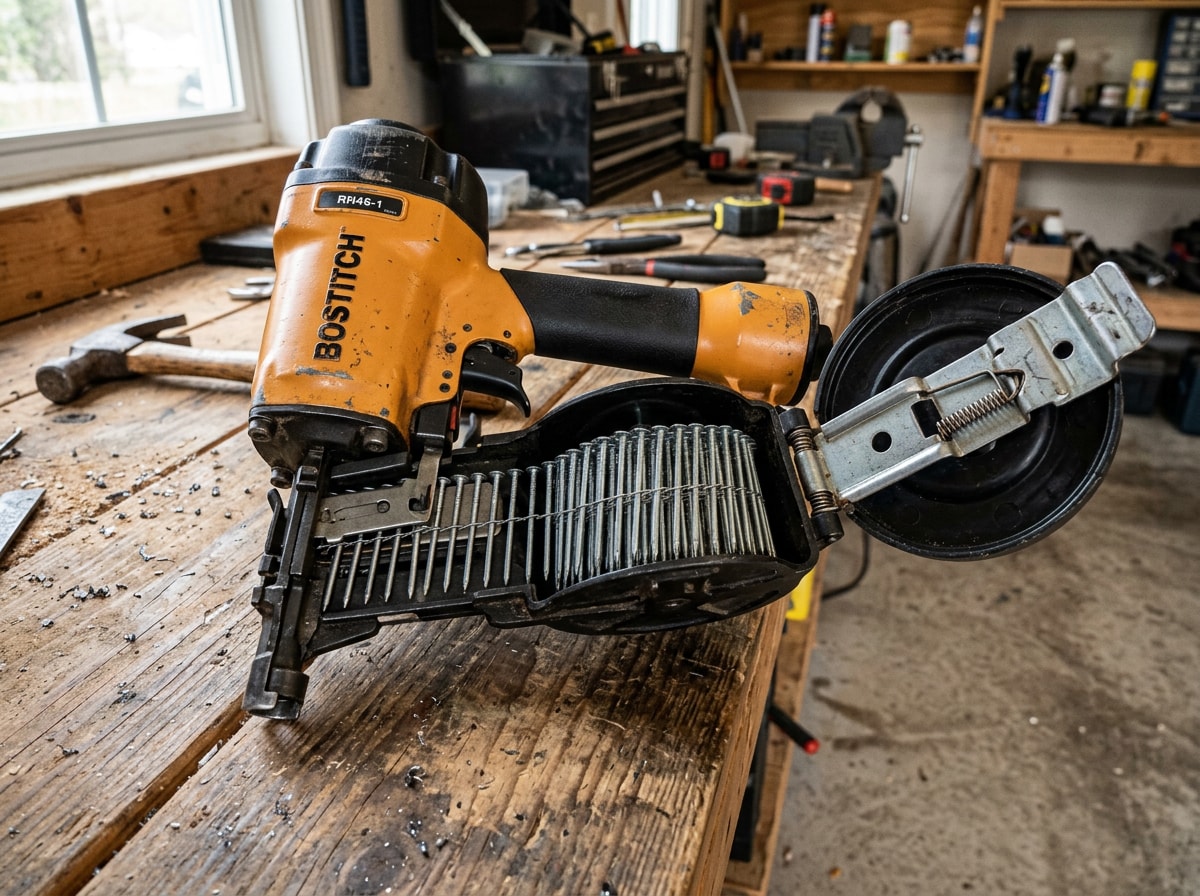
- Open the magazine and drop in the coil of nails without bending the collation wire.
- Align the lead nail with the feed mechanism.
- Match the nail-length mark on the nail guide to the nails you loaded.
- Close and lock the magazine.
- Reconnect air and fire a test nail into scrap material before starting real work.
Key Features to Look for in a Coil Roofing Nailer
Coil roofing nailer features vary more than the basic design suggests, so compare tools on the same handful of points before buying:
- Nail capacity: Look for a magazine that holds a full 120-nail coil to cut down on reload frequency on larger roofs.
- Coil angle: A true 15-degree wire-collated magazine is the roofing-specific standard; other angles usually signal a different nail type meant for another trade.
- Depth adjustment: Should be tool-free and easy to read mid-job, since shingle thickness and decking density both affect how deep a nail seats.
- Weight and balance: Anything under roughly 5 to 6 pounds is easier on the shoulder over a full day on a ladder or roof.
- Hose fitting and reload speed: A quick-release magazine saves real time across dozens of reloads per roof.
- Parts availability: Confirm replacement drive blades and O-rings are easy to source before the warranty runs out.
Nail Specs and Code: What Your Coil Nailer Must Fire
The nailer itself doesn't set nail requirements, the roofing nail code and shingle manufacturer specs do. Fasteners for asphalt shingles shall be galvanized steel, stainless steel, aluminum or copper roofing nails, minimum 12-gage shank with a minimum 3/8-inch-diameter head, of a length to penetrate through the roofing materials and not less than 3/4 inch into the roof sheathing.
Where the roof sheathing is less than 3/4 inch thick, the fasteners shall penetrate through the sheathing. You can review the full requirement in the International Code Council's IRC roof assemblies chapter.
Nails per shingle is typically four for standard installs, rising to six in high-wind zones, a figure set by code and shingle manufacturer instructions, not by the tool. The National Roofing Contractors Association recommends galvanized steel or the equivalent corrosion-resistant roofing nails for asphalt shingle installation and advises verifying governing building code requirements and shingle manufacturer recommendations .
Always confirm current requirements with your local building department, since amendments vary by region. If you're not sure whether an existing roof was fastened to code, a roof inspection will catch under-nailing before it turns into a wind-uplift claim. For a full punch list of what inspectors look at, see our roofing inspection checklist.
Pneumatic vs. Cordless: Which Setup Fits the Job
| Scenario | Best setup | Why |
|---|---|---|
| Full tear-off, compressor on site | Pneumatic | Unlimited air supply, lowest per-nail cost, less downtime |
| Repair or ridge work, small crew | Cordless | No hose to drag, faster setup for short jobs |
| No power or compressor access | Cordless | Battery-powered coil nailers now manage several hundred nails per charge |
| Large crew, high volume | Pneumatic | Multiple nailers run efficiently off one compressor |
Contractors commonly run pneumatic coil nailers from established lines like Bostitch, Metabo HPT, Makita, and MAX, alongside newer cordless options such as Milwaukee's battery-powered roofing nailers. Rather than ranking specific models, it's more useful to match the setup to the job in front of you.
Operating Tips for Efficiency and Safety
Keep the nailer perpendicular to the roof surface. Angling it even slightly tends to cause underdriven or blown-through nails.
Preload and test-fire on a scrap shingle at the start of every session, especially after a break where air pressure might have drifted. Keep air pressure consistent throughout the day: a compressor that's struggling to keep up will cause inconsistent depth even if your initial test-nail settings were correct.
Nail guns are also one of the more commonly underreported sources of jobsite injury. Nail guns are powerful and responsible for an estimated 37,000 emergency room visits each year, with 68% of these involving workers.
Research has identified that the risk of a nail gun injury is twice as high when using a multi-shot contact trigger as when using a single-shot sequential trigger nailer. Review OSHA's nail gun safety guidance before training a new crew member on the tool. Re-check depth whenever you switch nail lengths or shingle types mid-job.
Buying Guide: How to Choose the Right Coil Roofing Nailer
Start with coil capacity. A full 120-nail magazine pays for itself on anything larger than a small repair.
- Weigh ergonomic design heavily if the tool will be used all day; a lighter, well-balanced nailer reduces fatigue-related mis-hits more than any single spec sheet number.
- Check parts and service availability before buying, since a nailer that can't be repaired locally becomes dead weight fast.
- For occasional use, renting a quality pneumatic model often makes more financial sense than buying one that sits unused most of the year.
- If the roof is part of a larger roof replacement rather than a patch job, the fastening pattern matters as much as the tool, since under-nailing is one of the most common reasons shingles fail inspection or blow off early.
If you'd rather leave the fastening, and the ladder time, to a licensed crew, request a free estimate from Crestline Exteriors and we'll walk the roof with you before any nail gets fired.
FAQ
Is a Coil Nailer Better Than a Stick Nailer for Roofing?
Yes, for roofing specifically. A coil roofing nailer holds around 120 nails versus 30 to 40 in a stick magazine, and a 2,000 square foot shingle roof takes roughly 5,200 nails at four per shingle, meaning far fewer reloads with a coil tool. There are no production stick-fed nailers built for shingle work.
What Size Nails Does a Coil Roofing Nailer Use?
Standard coil roofing nailers fire nails from about 3/4 inch to 1-3/4 inches long, in roughly 11 to 12 gauge, with a wide head (typically 3/8 inch minimum) to meet code requirements for holding shingles securely.
How Much PSI Should a Coil Roofing Nailer Run At?
Most run between 70 and 120 PSI, but the right setting is whatever fully seats the nail flush without blowing through the shingle, usually 90 to 100 PSI for architectural shingles. Start low and increase in 5 PSI increments while test-firing on scrap material.
How Many CFM Does a Coil Roofing Nailer Need?
A single coil roofing nailer typically needs 3 to 6 CFM at 90 PSI; running two nailers off one compressor usually calls for a two-stage unit rated for 30 gallons or more. If pressure drops mid-coil even though the regulator reads correctly, the compressor's CFM, not its max PSI, is usually the bottleneck.
Pneumatic or Cordless Coil Roofing Nailer?
Choose pneumatic for full tear-offs and high-volume jobs where a compressor is already on site, since it's generally more cost-efficient per nail. Choose a battery-powered cordless nailer for repairs, ridge work, or sites without easy power access.
How Often Should I Service a Coil Roofing Nailer?
Clean the coil feed and magazine after every few jobs, and lubricate pneumatic models per the manufacturer's recommended interval, often daily during heavy use. Inspect the nose and drive blade for wear every few months, since a worn drive blade is a common cause of inconsistent nail depth.